

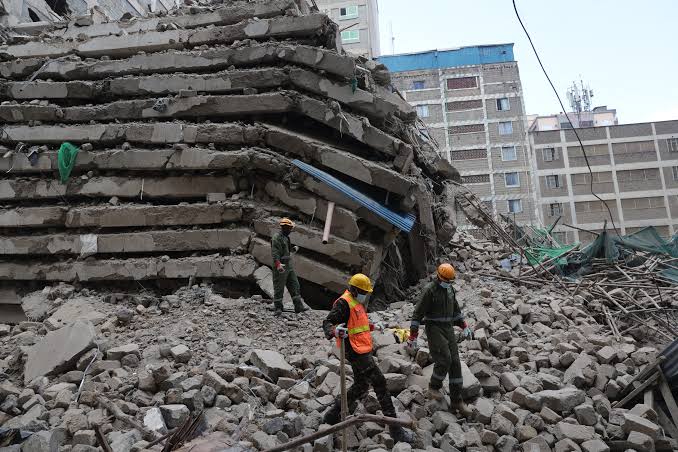
The catastrophic collapse of an 18-storey building on Eastleigh’s 9th Street is not a tragedy born of structural mystery. It is a crime born of institutional choice. When the columns of that massive development gave way, burying businesses and trapping dozens beneath thousands of tonnes of pulverized concrete, it wasn’t just a failure of engineering—it was a spectacular, fatal exposure of the syndicate that governs Nairobi’s real estate boom.
For days, a heavily coordinated multi-agency rescue effort involving the Kenya Red Cross, the Kenya Defence Forces, and international specialized teams like China’s Blue Sky Rescue has been digging through the gray wasteland of the rubble. They have pulled out survivors and recovered bodies, while distraught families wait behind police lines. But as the physical debris is cleared, the bureaucratic debris left behind paints a damning picture of a city where public safety is traded for private profit.
The regulatory post-mortem of the Eastleigh collapse reads like a masterclass in institutional evasion. In the immediate aftermath, a familiar choreography of blame-shifting began. Nairobi City County declared it had rejected the building’s architectural plans back in November 2024. NEMA revealed it had issued a non-compliance notice in early 2026 because the developer lacked an Environmental Impact Assessment. Meanwhile, the listed Project Engineer hastily washed his hands of the project, stating he had no involvement and was falsely registered on the site board.
This begs a fundamental question that City Hall consistently fails to answer: How does an 18-storey concrete monolith rise in broad daylight, over the course of two years, in one of Nairobi’s busiest commercial hubs, completely outside the law?
To blame rogue developers is a convenient cop-out. A developer can buy cheap, substandard steel, and they can illegally add extra floors to maximize rental income. But they cannot blindfold an entire municipal enforcement apparatus without systemic complicity. You cannot build 18 storeys in secret. The reality is that building inspectors, county planners, and enforcement officers walked past 9th Street every single week. Their silence was bought, and the price was paid in human lives.
This crisis of impunity extends into the digital shadows of governance. In a telling anomaly, investigators noted that the project’s data was completely missing from the National Construction Authority online portal on the night of the collapse, only to mysteriously appear the following morning. When regulatory registries can be retroactively manipulated to shield or expose actors after a body count accumulates, the system isn’t just broken—it is actively weaponized against the public.
The human cost of this greed is exacerbated by sheer recklessness. Even as scaffolding wrapped around the upper storeys of the incomplete tower, 11 retail shops were already fully operational on the lower floors. Lower-income traders and workers were lured into a death trap, conducting business beneath a structural time bomb because the developer could not wait to collect rent.
Eastleigh is not an isolated incident; it is the logical conclusion of Nairobi’s laissez-faire urban planning. Between 2009 and 2019, Kenya recorded at least 86 major building collapses, a grim tally that continues to grow with recent failures near the CBD’s OTC junction and in Kibera. We are witnessing an unprecedented urban development boom built entirely on a foundation of sand, corruption, and political patronage.
The Director of Public Prosecutions has ordered the DCI to launch a comprehensive criminal inquiry, and police are hunting for the directors of 9th Street Plaza Limited. But standard criminal investigations are no longer enough. We do not just need a manhunt for a few runaway developers; we need a structural overhaul of City Hall.
Until municipal approval officials, corrupt inspectors, and complicit county planners are paraded in court alongside the rogue contractors they protect, these towers will keep falling. Nairobi’s skyline will continue to rise, not as a symbol of economic progress, but as a monument to unchecked greed and institutional betrayal.
